
How to Dress Expensive on Any Budget

Nora Whitmore
7 min read

Expensive-looking outfits are built from decisions, not price tags.
Walk through any city and you will see people in costly clothes who look unremarkable, and people in high-street pieces who look like they stepped out of an editorial. The difference is rarely the money. It is colour, fabric, fit and restraint — four things that cost attention rather than cash.
This guide walks through each one. None of them require buying anything today; most of them are about using what you already own more deliberately.
Start with the one that has the biggest effect: colour.
Choose Colors That Look Intentional
Cheap-looking outfits are usually not cheap. They are random.
A random outfit contains colours that do not relate to each other: a warm top, a cool trouser, a neutral that belongs to neither. The eye reads the lack of relationship as carelessness, and carelessness reads as cheap.
An intentional outfit keeps all its colours in one temperature. Warm with warm — camel, rust, olive, cream. Cool with cool — charcoal, navy, slate, icy grey. Once the temperature agrees, almost any combination inside it looks considered.
The second layer is contrast. High contrast (black and white, navy and cream) looks crisp and formal. Low contrast (camel and tan, grey and silver) looks soft and expensive. Both work; mixing them randomly does not.
Finally, tie the outfit to your own colouring. Neutrals that echo your hair, skin or eyes always look like they belong on you — which is the definition of expensive-looking.
If you only change one thing after reading this, make it this: stop buying colours because you like them on the hanger and start buying colours that agree with each other and with you.
It costs nothing and it is the single most visible upgrade available.
Pay Attention to Fabric First
The eye judges fabric before it judges anything else, and it does so from several metres away.
Thin, shiny synthetics catch light unevenly and cling where they should drape. Dense, matte fabrics — wool, heavy cotton, linen, thick knits — absorb light and hold a shape. Even a cheap wool blend will usually look more expensive than a polyester at three times the price.
When you shop, touch before you look. Fabric that feels substantial in the hand will photograph and wear as substantial.
Your wardrobe can
feel easier.
Discover your personal colors, outfit ideas, and guidance designed around your life and your style.
Some quick tells for quality at any price: a knit that does not go see-through when stretched, a trouser that falls straight rather than pooling, a shirt that stays opaque under a light.
Care matters too. Steamed, pressed and lint-free will always outclass creased and pilled, regardless of what the label says.
A steamer is the highest-return purchase in this whole article.
Fit Is Everything
Fit is where most of the expensive impression is won or lost.
Expensive-looking clothes fit at three points: the shoulder, the waist and the hem. Get those three right and the rest of the garment is forgiven.
Shoulder seams sit on the shoulder bone — not dropped, not pulled in.
Waists sit where your waist actually is, and they hold that line rather than sagging below it. If a trouser or skirt slides down through the day, it does not fit, however good it looked at the mirror.
Hems land at a deliberate point: the ankle bone for a straight trouser, the top of the shoe for a wide one, just above or just below the knee for a skirt. A hem that lands in between reads as unfinished.
A tailor fixes all three for less than the price of a new garment, and the same garment, tailored, will look like it cost double.
Fit beats brand every single time.
Keep Silhouettes Clean and Structured
Expensive style is quiet at the outline. Think of the shapes: a straight coat, a column of a dress, a tapered but not tight trouser.
Clean silhouettes come from structure — a bit of weight in the shoulder, a defined waist, a hem that holds. Soft, shapeless pieces can be beautiful, but they need a structured piece next to them or the whole outfit collapses into loungewear.
A useful habit: pair one structured piece with one soft piece. Blazer with a knit. Crisp shirt with fluid trousers. Structured bag with a soft dress.
Never all soft, rarely all structured.
Limit Visual Clutter
Clutter is the enemy of expensive. Clutter means anything that pulls the eye without adding to the outfit.
Visible logos are clutter. So are competing prints, multiple accent colours, and accessories that do not share a metal.
Detail is fine — a beautiful button, a contrast stitch, an interesting collar — but detail should be singular. One point of interest per outfit; the rest of the outfit exists to support it.
If you photograph your outfit and something in the picture draws your eye before your face does, that thing is probably clutter.
Remove it and look again.
Build Around Elevated Basics
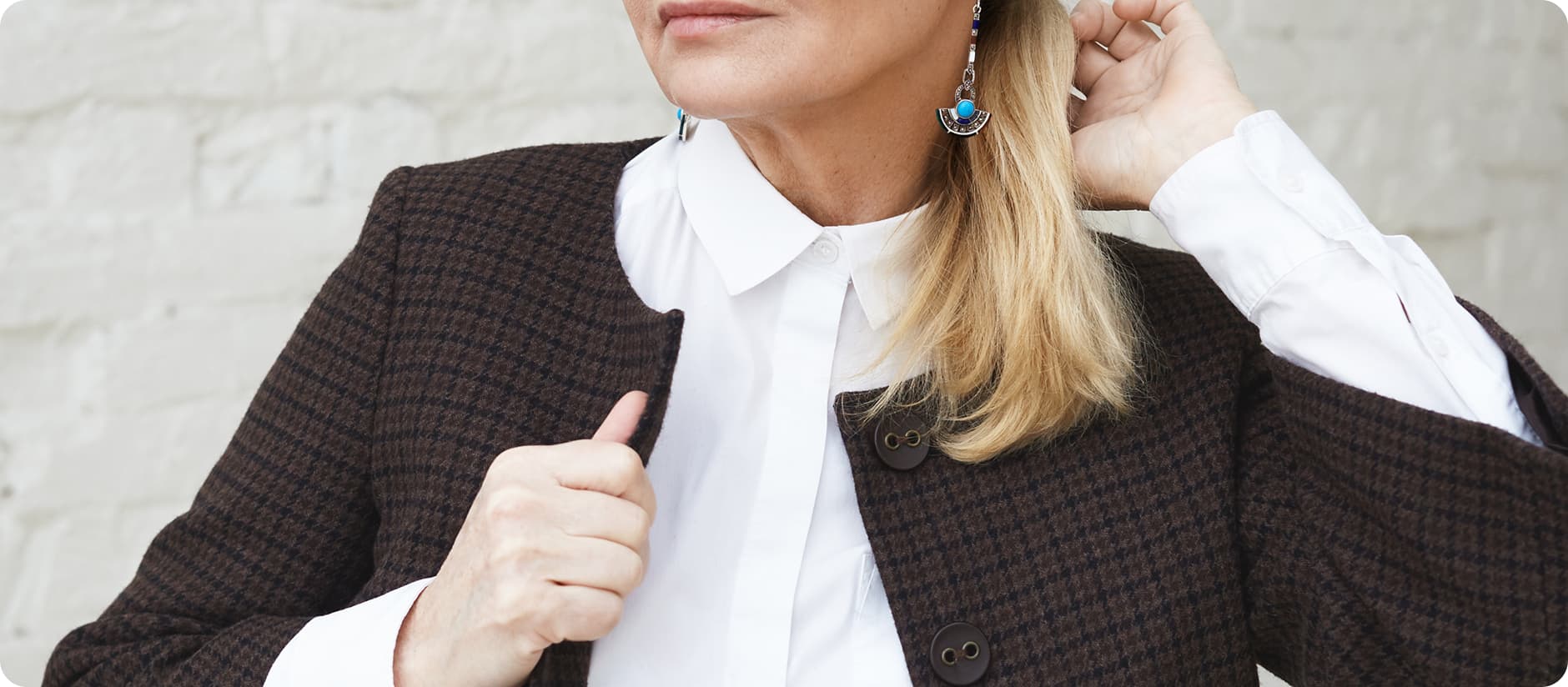
A wardrobe that looks expensive is built on a small number of basics that fit perfectly and sit in your palette. Everything else is layered on top of them.
- a straight-leg trouser in your darkest neutral
- a white or off-white shirt that fits at the shoulder
- a fine-gauge knit in a neutral that echoes your hair colour
- a blazer or structured jacket with a real shoulder
- one pair of polished shoes that matches your metal
These five pieces alone produce a dozen outfits that look intentional. Add one statement piece per season and the wardrobe feels new without needing to be.
Spend your money here, on the pieces you wear every week, and save on the pieces you wear twice a year.
Final Thoughts
Looking expensive is a set of habits: colours that agree with each other and with you; fabrics that hold their shape; fit at the shoulder, waist and hem; a clean silhouette; one point of interest.
None of those habits are about spending more. Most of them are about spending less — on fewer, better-chosen things worn more often.
Practise them with what you already own first. The upgrade is immediate, and it will change what you buy next.
That is the real difference between expensive clothes and expensive style.